

Djokovic Documentary Premieres Above Kotor: ‘The Wolf in Winter’ Screened on Lovćen
An exclusive interview with Maria Broman, CEO of Semrén & Månsson International.
The Scandinavian approach to architecture is, above all, about respect. Respect for the individual, for the site where the project is realized, and for the surrounding environment. In the new Boka Verde development, the Swedish bureau Semrén & Månsson solved a complex equation: how to transpose Scandinavian functionality onto the leisurely Adriatic landscape. We spoke with the concept’s author, Maria Broman, about "green" facades, the philosophy of living, and how complex terrain creates entirely new scenarios for comfort.
Forbes: Maria, Tivat possesses a distinct landscape where the mountains descend rather abruptly to the sea. For many developers, such relief poses a serious engineering challenge. What does this context mean to you?
Maria Broman: For us, it is primarily a source of inspiration, not a problem. We decided not to fight the landscape, but to utilize it. This is the exact approach we implemented in Boka Verde.
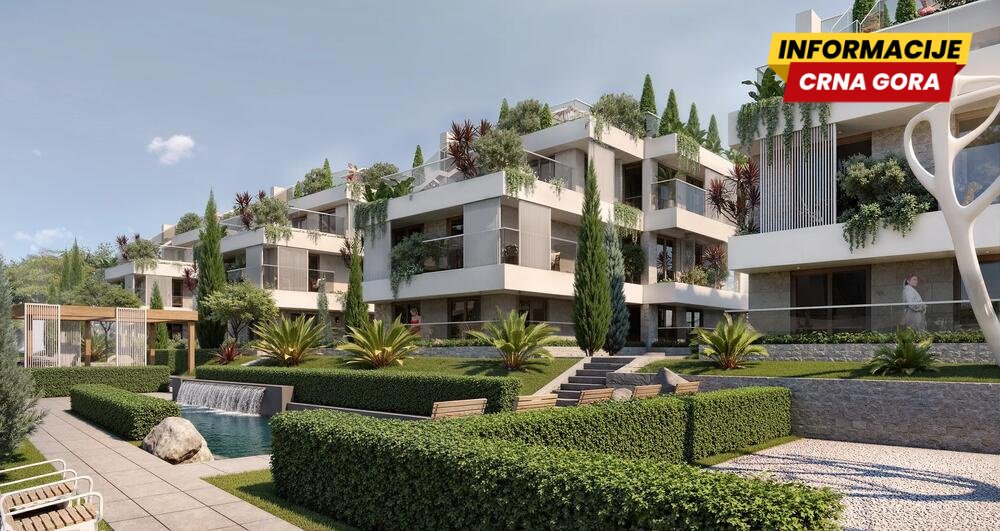
The master plan concept is built on the idea of cascading. The buildings do not obstruct one another; instead, they step gently down the slope. This allowed us not only to ensure maximum views for the residences but also to form interesting, non-trivial spatial solutions. It was precisely this complex relief that allowed us to lay the foundation for entirely new living scenarios and create a multi-layered system of privacy. You remain within the social fabric, yet the architecture itself guards your personal space.
Forbes: You mentioned that the relief allowed for the creation of "new living scenarios." What formats are you referring to?
Maria Broman: The most striking example of how topography influences quality of life is our lower levels. Typically, the "ground floor" is associated with a lack of privacy. But here, Tivat’s complex terrain played into our hands.
Our Garden Apartments are not actually at ground level—they are elevated above it. The result is a remarkable effect: the apartment has its own private garden, but it literally "floats" above the level of the internal park. Residents enjoy direct contact with the earth and greenery, much like in a private villa, yet they remain visually inaccessible from the outside. This is a case where the complex geography of the site dictated the superior solution.
Forbes: In the project description, you frequently use the term "biophilic design." How is this implemented in practice, beyond standard landscaping?
Maria Broman: Biophilia is about blurring the boundaries between the interior and the outdoors. At Boka Verde, we designed "green facades." This is not merely decoration. Living plants integrated into the building structure, combined with natural stone and wood, act as a natural filter. They provide shading, protect against overheating, and visually dissolve the buildings into the greenery. The complex does not appear as a foreign concrete patch; it mimics the surrounding environment.
Forbes: Special attention in the project is given to the internal territory. What is the core idea of this space?
Maria Broman: We wanted to create not just a courtyard, but a fully-fledged "open-air living room."
The first and most critical decision was to move all vehicular traffic entirely underground. The surface is dedicated to people. The space is programmed for various scenarios: there are quiet zones for work and yoga, playgrounds, and a swimming pool. And once again, the relief aided us: thanks to the terracing of the park, the active children's zone does not disturb those wishing to read a book in the shade of the trees. It is a safe, green environment where one can comfortably spend the entire day.
Forbes: What is the primary emotion that a person living in Boka Verde should experience?
Maria Broman: A sense of balance. We aimed to create an environment where modern urban comfort does not conflict with nature. It is a place where one can slow down without losing connection to the world. Swedish quality of life within a Montenegrin setting.
The ambitious concept of Boka Verde places the project alongside global icons of "green" architecture, such as ACROS Fukuoka in Japan, the renowned Bosco Verticale in Milan, and One Central Park in Sydney.
The integration of living plants into the structural facades and the creation of a self-sustaining ecosystem within the complex allow us to speak of Boka Verde not merely as a residential development, but as a new architectural landmark of Tivat—one with every chance of becoming a textbook example of biophilic urbanism.
Boka Verde — A new standard combining Scandinavian functionality with the measured life on the Adriatic coast.
Project Status The project will be realized in two phases, with the planned completion of the first phase in 2027 and the second in 2028.
Our Instagram: https://www.instagram.com/boka_verde__tivat_montenegro/
Our Linkedln: https://www.linkedin.com/company/111074968/